Introduction
Partisia's Decentralized Identity (DID) product lets your organization issue and verify verifiable credentials, so the people you serve carry their own data instead of leaving it in your database. This section takes you from the concepts, through a working local deployment, to an integration in your own application.
If you would rather see it running before you read about it, start with the quickstart.
Why Decentralized Identities?
Decentralized identities, also known as Self-Sovereign Identities (SSI) or reusable IDs, are designed to give individuals full control over their digital identities and data without relying on centralized authorities. At the core of this concept is the principle that users own their personal data and can grant consent on a per-use basis.
In the simplest decentralized identity scenario, the holder (typically the end user) shares all the claims (e.g., age, height, nationality) contained in a verifiable credential, giving the verifier access to this information. As part of this simple presentation -and as in any other decentralized identity interaction- the verifier can easily confirm the credential's integrity and authenticity without contacting the original issuer, thereby preserving the end user's privacy.
Additionally, on top of this basic flow, decentralized identities also support even greater privacy-enhancing options:
- Selective disclosure: Reveal only the exact attributes needed for a transaction -no oversharing of personal details.
- Zero-knowledge proofs: Prove statements (e.g., age > 18) without exposing the underlying data.
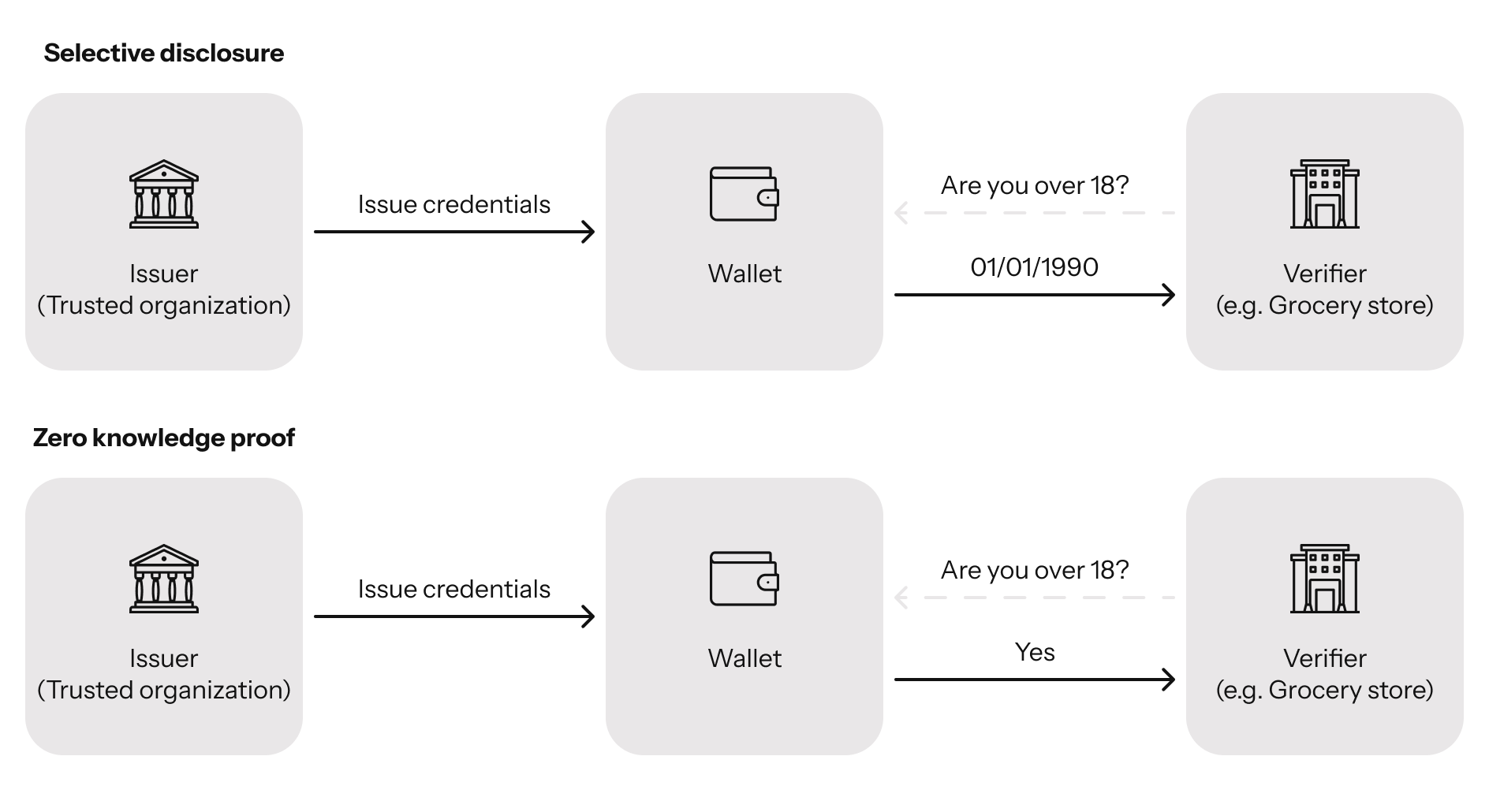
The following illustration shows the practical use of selective disclosure and zero-knowledge proofs: as the reader can notice, only the birthdate, or a simple yes/no is disclosed -not the entire credential or any additional information.
To sum up, decentralized identities are built with these principles in mind:
- Decentralized control: Ownership and management of verifiable credentials happen without reliance on any central authority that could surveil or control individuals.
- Native interoperability: Built on open standards such as W3C Verifiable Credentials Data Model v2.0, decentralized identities are designed to work seamlessly across diverse contexts and regions.
- Privacy-first approach: Leverage selective disclosure and zero-knowledge proofs to ensure only minimal necessary attributes are revealed, protecting users' privacy.
- Embedded trust: Cryptographic signatures, validated against a trust anchor the verifier already holds, let verifiers independently confirm the authenticity and integrity of credentials without contacting the issuer. See Trust model.
Why Should Organizations Care?
- Regulatory drivers: EU regulations such as eIDAS 2.0 mandate adopting decentralized identities, requiring acceptance of digital wallets and verifiable credentials. With similar laws emerging globally, early adopters will achieve compliance faster and gain a competitive edge.
- Better user experience: Slow onboarding processes cause 48% of banks to lose clients. Decentralized identities allow users to reuse credentials across services, eliminating redundant checks, enhancing user experience, and boosting conversion.
- Enhanced efficiency: Traditional KYC checks are estimated to cost between $1,500 and $3,500 per verification, largely due to manual, repetitive compliance procedures. Decentralized identities are designed to improve efficiency by eliminating redundant checks, reducing compliance costs, and minimizing data-handling risks.
What Are Verifiable Credentials?
Verifiable credentials are tamper-evident digital credentials — also referred to as cryptographically verifiable assertions or digital attestations — that contain claims about a subject, such as a name, an age or a qualification. A credential is issued by a trusted entity and digitally signed, held by its subject in a digital wallet, and verified by any third party through cryptographic checks alone, without contacting the issuer. That makes them well-suited to digital identity management and to asynchronous data sharing.
A credential is what the holder stores; a verifiable presentation is what the holder sends to a verifier. A presentation is assembled per request, signed by the wallet, and can contain a subset of a credential's claims. See Terminology.
How It Works introduces the three parties — issuer, wallet and verifier — and what each one does.
Decentralized vs Centralized
Decentralized identities enhance privacy, security, and transparency by breaking down barriers between siloed systems and giving users true ownership of their digital identities.
| Aspect | Centralized Model | Decentralized Model |
|---|---|---|
| Data Ownership | Held by a central authority; subject to surveillance and unilateral policy changes. | Controlled by users, who grant access and consent on a per-use basis. |
| Privacy & Security | High risk of large-scale data breaches; limited transparency. | Privacy-preserving through selective disclosure and zero-knowledge proofs. |
| Scalability | Vertical scaling; costly infrastructure upgrades; vendor lock-in. | Open networks drive adoption. |
| Interoperability | Proprietary protocols; integration overhead. | Open standards enable plug-and-play integration across regions. |
| Resilience | Single points of failure; downtime impacts all users. | Distributed consensus and redundancy mitigate outages and censorship. |
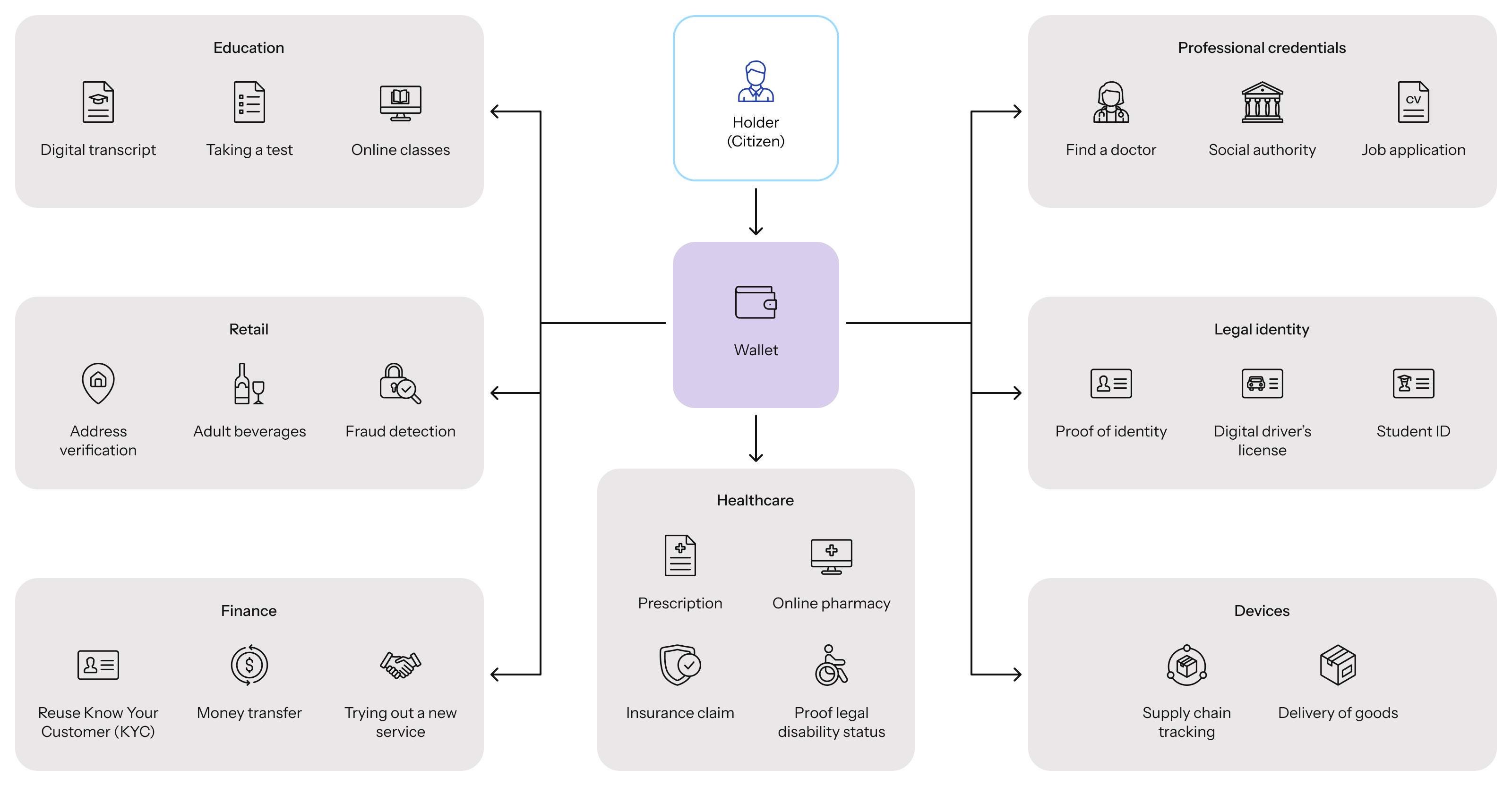
Trusted ecosystems built on verifiable credentials are emerging across a wide range of use cases:
Prerequisites
You run the issuer and verifier yourself. To follow this documentation you need:
- Docker with the Compose plugin, and OpenSSL for generating a signing certificate.
- Access to Partisia's container registry to pull the backend images. Please book a call with us to arrange it.
- A wallet to hold credentials. The Partisia ID Wallet is a public app you can install from Google Play or the App Store.
The backends store their state in PostgreSQL and establish trust with X.509 certificates.
What's Next
- Quickstart: Run the issuer and verifier locally and issue your first credential.
- How It Works: The components involved, and a worked end-to-end example.
- Trust Model: How a verifier decides that a credential came from an issuer it trusts.
- Standardization: The open standards this product implements.